Showing posts with label Data. Show all posts

Friday, April 11, 2014

2014 Early Entry Analysis: Deadline Decisions


With the NCAA tournament over, college basketball players and other NBA draft hopefuls have little time to make a life-altering decision. Despite several sources of "information", it's difficult to find any reliable data. With that in mind, I've tried to look at this from the perspective of the best, publicly available information: the mock drafts of DraftExpress and NBADraft.net as of today.

The past three years (2011-2013 NBA Drafts), I've written this post using the mock drafts available at the time (post-tournament, pre-deadline), not at the beginning of the season or the week before the draft. This way, it's a true(r) representation of the imperfect information that's out there. What have the past three years shown about how useful my typical tiers are?

1. PROJECTED LOTTERY PICKS ARE VERY LIKELY TO BE DRAFTED IN THE 1ST ROUND.


In the last three years of NBA drafts, 33-40 players have chosen to enter the draft that were projected as a lottery pick by one or two of the mock drafts. All of those players ended up being drafted in the 1st round, and at least 80% of them ended up lottery picks. They may not have signed for as much money as they hoped, but they were signing guaranteed rookie contracts.

2. PROJECTED 1ST ROUND PICKS OUTSIDE THE LOTTERY ARE MEANINGFULLY LESS LIKELY TO BE DRAFTED IN THE 1ST ROUND.


For the players that went into the draft as projected 1st round picks outside the lottery, the chances of falling out of the 1st round are much higher. While this idea is easily accepted without digging into data, consider the magnitude: for every three players that thought they were a mid-teens to late 1st round pick based on a mock draft, one of them fell to the 2nd round. That is a very real risk to consider.

3. BEING IN BOTH MOCK DRAFTS MATTERS, ESPECIALLY OUTSIDE THE LOTTERY.

Again, this seems like an intuitive point, but the magnitude is significant. Being a lottery pick on both mock drafts means seven out of eight guys will go in the lottery, versus four out of five going with only one site. Outside the lottery, being in both mock 1st rounds meant that a player significantly reduced the chance of falling out of the 1st round altogether.

Now, the sample size (three years) isn't nearly big enough to point to anything as a definitive trend, but at a minimum, it should indicate that the concept of this post is at least pointed in the right direction. Unless you're the type of person that says mock drafts have no value whatsoever, in which case, there's nothing I can say to change your mind. Now, without further ado, on to the (new and improved) tiers...

TIER 1. LOTTERY PICKS (LIKELY 1ST ROUNDERS) 

Despite all the hand-wringing over the top prospects, the consensus lottery picks (shaded in blue) are pretty familiar names to most people that look at potential draftees throughout the college basketball season. The non-consensus guys are the typical mix of international prospects that may or may not come out, and prospects with diverging opinions. Based on the last three years, these guys have a good shot of going in the lottery, and a very good shot of going in the 1st round if they enter the draft. It's also of note that despite the roller-coaster season Marcus Smart had as sophomore relative to his breakout freshman year, his standing as a mid-to-high lottery pick does not appear to be affected at this point.  

TIER 2. POSSIBLE 1ST ROUND PICKS.

For guys in this group, the potential for falling out of the 1st round is real. As a result, they are probably considering a few factors with regard to coming out this year: 1) the quality of their individual prospects next year; 2) the quality of their team prospects next year; 3) remaining work towards graduation; and 4) any personal situations that prioritize a professional career sooner rather than later. For some guys, the decision to come out is already made, but for others, this is a very difficult call. I would simply echo the following: seven guys on this list are projected as "consensus" 1st round draft picks. If recent history holds, then it's likely that one (or more) of those seven players falls out of the 1st round.  And, including both tiers, there are 35 projected 1st round picks, and only 30 actual 1st round picks. 


Friday, December 27, 2013

SportVU Data: Identifying the League's Best... Drivers

With the release of SportVU camera tracking data to the general public via NBA.com, there's a whole new world of information available to try and figure out what's happening on an NBA court, and who's doing it well (or poorly). Really, an ideal application should be to identify the best players filling certain roles on a team, because good role players can swing a playoff series. While understanding all this data has to be in its infant stages, here's a quick look at a few things that seem useful right off the bat. The data is pulled from here, and some summary rules for how I cut the stats are included at the bottom of each post.


In today's NBA, the ability to create a good shot out of nothing has value. Similarly, players that effectively drive to the rim can warp a defense and, if done well, produce points for himself and his team in an efficient way. Here's a look, through the season to date, at some of the most prolific (and efficient) drivers to the hoop. They're identified by how many points a player produces per drive, for himself and for his team.


A few thoughts on the players listed above:
  • While they may not be getting a lot of the All-Star fan vote at this point, hopefully coaches have noticed Ty Lawson and Jeff Teague. They're driving to the rim a lot, and producing points efficiently for their teams, primarily via shots for their teammates. Given the offensive burdens that both guys carry, that should merit consideration.
  • Patrick Beverley brings other things to the table (notably, on-ball defense) better than Jeremy Lin. But, as a driver to the rim, Lin has been much more efficient (1.15 points per drive) than Beverley (0.99). Now, whether the Houston offense is designed for two guys to drive the ball, with Dwight Howard inside, remains to be seen. 
  • I'm not sure whether Tyreke Evans and Jrue Holiday being on this list is a testament to their individual talents blossoming in New Orleans, or the power of Ryan Anderson's otherworldly outside shooting, or both. I haven't watched enough Pelicans basketball to guess, so I won't.
  • Isaiah Thomas is probably someone I should be watching a lot more of. How he manages to produce just some of his offensive numbers, given everything that swirls around him in Sacramento, plus his height, plus his "Mr. Irrelevant" draft status, seems like a great feel-good story.
Eligibility Rules:
 - Top 100 drives per game
 - Must have produced at least 1.15 team points per drive (average for the group)
 - Ranked by drives per minute


Saturday, December 14, 2013

SportVU Data: Identifying the League's Best... Rim Protectors

With the release of SportVU camera tracking data to the general public via NBA.com, there's a whole new world of information available to try and figure out what's happening on an NBA court, and who's doing it well (or poorly). Really, an ideal application should be to identify the best players filling certain roles on a team, because good role players can swing a playoff series. While understanding all this data has to be in its infant stages, here's a quick look at a few things that seem useful right off the bat. The data is pulled from here, and some summary rules for how I cut the stats are included at the bottom of each post.


In today's NBA, the two most efficient shots tend to be corner three's and attempts at the rim. In fact, over the last five years, NBA players shoot an average of around 60% on attempts at the rim. Based on that, players that can lower opponent's success at that shot can be game-changers. Here are standouts at defending the rim so far this season.

Chris Kaman, Lakers (opponents shooting 36.4% on 5.9 attempts in 16.9 minutes)
Robin Lopez, Blazers (opponents shooting 44.4% on 10.6 attempts in 30.8 minutes)
Roy Hibbert, Pacers (opponents shooting 40.5% on 9.6 attempts in 31.1 minutes)
Vitor Faverani, Celtics (opponents shooting 44.8% on 4.6 attempts in 15.1 minutes)
Andrew Bogut, Warriors (opponents shooting 45.9% on 8.3 attempts in 28 minutes)
Brook Lopez, Nets (opponents shooting 39.7% on 9.1 attempts in 30.7 minutes)
Omer Asik, Rockets (opponents shooting 43.2% on 5.2 attempts in 18.3 minutes)
Tim Duncan, Spurs (opponents shooting 43.4% on 7.6 attempts in 27.9 minutes)
Serge Ibaka, Thunder (opponents shooting 45.3% on 9.1 attempts in 33.8 minutes)
Ekpe Udoh, Bucks (opponents shooting 45.2% on 5.8 attempts in 22.4 minutes)

A few things that jump out at me about this list.
  • How about the Lopez brothers, and I do mean both of them. Robin Lopez is part of a really fun-to-watch Blazers team, and his play allowing LaMarcus Aldridge to slide over to power forward is an under-rated reason why. Brook has always been chided for his lack of rebounding, but who knew he was this active (and effective) challenging shots at the rim?
  • It seems like people are really harping on Omer Asik after whatever happened the last few weeks in Houston, as though it negatively affects his prospects as a player. Well, he's still bringing his bread and butter to the table this season, and these kinds of contributions matter a lot in the playoffs.
  • He didn't make the list, but in case you're curious, Andre Drummond's overall blocks are down this year, but he's holding opponents to 45.7% at the rim on 7.8 attempts. I could've eliminated guys like Kaman and Faverani for low minutes totals, but then again, that's what everyone said about Drummond last year.
Rim Protector Eligibility Rules:
 - Top 100 players in opponent field goal attempts at the rim
 - Played more than 13 games
 - Played more than 15 minutes per game
 - Allow opponents to shoot 46% or less

Sunday, December 8, 2013

SportVU Data: Identifying the League's Best... Catch and Shoot Players

With the release of SportVU camera tracking data to the general public via NBA.com, there's a whole new world of information available to try and figure out what's happening on an NBA court, and who's doing it well (or poorly). Really, an ideal application should be to identify the best players filling certain roles on a team, because good role players can swing a playoff series. While understanding all this data has to be in its infant stages, here's a quick look at a few things that seem useful right off the bat. The data is pulled from here, and some summary rules for how I cut the stats are included at the bottom of each post.

CATCH AND SHOOT: THREES


In a league with increasingly zone-based defensive principles, spacing is at a premium. As a result, so are players that stretch a defense with the threat of catching and shooting the ball from deep. Through the season to date, the following players stand out in executing this role.

Gerald Green, Suns (5.6 attempts per game in 27.8 minutes, 38.4%) 
Tim Hardaway Jr., Knicks (3.1 attempts per game in 16.1 minutes, 42.3%)
Ryan Anderson, Pelicans (6.6 attempts per game in 35.7 minutes, 51.5%)
Cartier Martin, Hawks (3.4 attempts per game in 19.5 minutes, 40.8%)
Martell Webster, Wizards (5.6 attempts per game in 32.7 minutes, 41.1%)
Channing Frye, Suns (4.3 attempts per game in 26.9 minutes, 41.2%)
Klay Thompson, Warriors (5.9 attempts per game in 37.7 minutes, 47.8%)
JR Smith, Knicks (4.8 attempts per game in 31.1 minutes, 41.3%)
Randy Foye, Nuggets (3.9 attempts per game in 25.6 minutes, 40.5%)
Trevor Ariza, Wizards (5.3 attempts per game in 36.1 minutes, 48.6%)

Looking at that list, a few things jump out. First, I'm surprised that the Knicks and Wizards haven't been better offensive teams to date, since both Wall and Anthony seem to have decent safety valve options on the wing. Second, Ryan Anderson and Klay Thompson are off the charts efficient, to the point where they must warp a defensive scheme whenever they're in a game (or should). Third, if anyone wonders why 38% was the cutoff for this list, it's because I wasn't going to omit Gerald Green, who's shooting more catch and shoot threes per minute than anyone in the league, and hitting a respectable amount of them.

CATCH AND SHOOT: TWOS


The two point catch and shoot specialists are purposely attempting the most inefficient shot in basketball, and attempting to do so at a high level. While it's easy to say that midrange jumpers should never be attempted, at the end of a shot clock, or against a good defense (or both), sometimes a player on the floor has to be able to hit this shot when it's conceded. Through the season to date, the following players stand out in executing this role.

Darrell Arthur, Nuggets (4.1 attempts per game in 18.1 minutes, 46.3%)
Jason Smith, Pelicans (6.2 attempts per game in 28 minutes, 48.4%)
Luis Scola, Pacers (3.3 attempts per game in 18.5 minutes, 54.6%)
LaMarcus Aldridge, Blazers (5.5 attempts per game in 37.1 minutes, 50.9%)
Al Horford, Hawks (4.5 attempts per game in 32.8 minutes, 51.1%)
Andrea Bargnani, Knicks (3.9 attempts per game in 31.2 minutes, 59.0%)
Dirk Nowitzki, Mavericks (4.0 attempts per game in 32.5 minutes, 55.0%)
Serge Ibaka, Thunder (4.1 attempts per game in 34.6 minutes, 46.3%)
David West, Pacers (3.5 attempts per game in 30.4 minutes, 57.1%)
Chris Bosh, Heat (3.1 attempts per game in 28.7 minutes, 45.2%)

A few thoughts here. First, it's interesting how many good teams (Heat, Pacers, Thunder, Blazers) seem to have someone who's very good at hitting these shots. Second, for all the heat he's taken for his entire career, at the very least Andrea Bargnani has been a lethal pick and pop guy this year, as long as he's inside the arc. Finally, is there anything Al Horford can't do? If the Hawks aren't trying to contend this year, and are planning on pulling the plug in February, he has to be the hottest commodity at the trade deadline for a contender (e.g. Clippers, Thunder).

3 Point Catch and Shoot Eligibility Rules:
 - Top 100 in total Catch and Shoot Attempts
 - At least 10 games played
 - Volume Shooters (ranked by attempts per minute)
 - 38+% on attempts

2 Point Catch and Shoot Eligibility Rules:
 - Top 100 in total Catch and Shoot Attempts
 - At least 10 games played
 - Volume Shooters (ranked by attempts per minute)
 - 45+%  on attempts


Sunday, February 10, 2013

NBA Luxury Tax Summary

I've had a few requests for additional analysis of specific teams following the post on the new luxury tax. Without delving into every NBA team, this should provide a quick way to look at the current payroll of any NBA team, and the potential taxes. First, here's a great summary of NBA team payrolls by Basketball Reference. What could the tax for team X look like? 
 
Here's how the new luxury tax rates are calculated:
 
 
The $70.3 million starting point is based on the level for the 2012-2013 season. The tax increases don't stop here, though... they increase by $0.50 for every additional $5 million of a team's payroll. So, for a regular taxpayer, payroll above $100.3 million would be taxes at $4.75, and so on.
 
Based on that math, here's a quick summary of the tax bills for teams at different payroll levels going forward:
 
 
 It should be noted that the payroll numbers don't include things that are very likely, but haven't officially occurred (e.g. Chris Paul re-signing with the Clippers, next year's 1st round salaries, rookie deal extensions, etc.). There are a lot of hypotheticals to consider, but this is at least a starting point.

Monday, October 15, 2012

Preseason View of the 2013 Draft Class

(Preseason View of the 2012 Draft Class)

Now that Midnight Madness has officially started the college basketball season, it's as good a time as any to look at those prospects already high on the radar screens of the NBA. This is, by no means, an exact science... of the 9 consensus lottery picks on the two noted mock drafts last year, 6 were actually drafted in the lottery. But, this could still help identify teams to watch during the season (example: last year's list convinced me to watch more Washington games than planned).

 
TIER 1: LOTTERY PICKS (8 Consensus, 15 Total)
Last Year: 13 Players, 11 Declared, 11 Drafted, 10 1st Rounders, 7 Lottery Picks 
 
The top 4 appear to be pretty set in stone, and Kentucky has three prospects as consensus lottery, versus two last year (hard to believe the metoric rise of MKG in twelve months as far as draft boards were concerned). As always, the fall risks always appear to be the guys that came back. A year ago Perry Jones and Jared Sullinger were considered lottery locks as returning sophomores. The only two who could be on the same path are Cody Zeller and James McAdoo, with McAdoo the bigger fall risk of the two.


TIER 2: 1ST ROUND CONSIDERATION (10 Consensus, 28 Total)
Last year: 21 Players, 11 Declared, 11 Drafted, 6 1st Rounders, 3 Lottery

There's a lot more debate at the bottom of the 1st round than last year, but it's so dependent on who declares and who doesn't, it's hard to nail any of these down. The most intriguing guys to start the year should be Austin, the Baylor freshman, followed by the eerily-similar-to-Jeff-Green Otto Porter at Georgetown. Outside of that, there's the usual collection of untapped raw potential (Austin, Mbakwe, Leslie, Dieng, Smith), older players with perceived lower ceilings (McCollum, Plumlee, McDermott), and some best guesses.

The best part about this? Guys like Michael Kidd-Gilchrist, Dion Waiters, Damian Lillard, and Meyers Leonard. Guys that weren't in either group last year, all lottery picks in June. As a whole, there's a lot we think we know, and even more that we don't know.

Sunday, April 8, 2012

Are College All-Star Teams a Blind Spot for NBA GM's?

As this blog has noted several times, consistent success in the NBA is significantly influenced by success or failure in the draft. It remains the major source for franchise cornerstone talent for all organizations, and seeing the difference between getting it right and getting it wrong is sometimes as easy as looking at Dwight Howard and Emeka Okafor. However, for all the opportunity and optimism, it's still not that easy to land one of the best talents in the NBA via the draft.


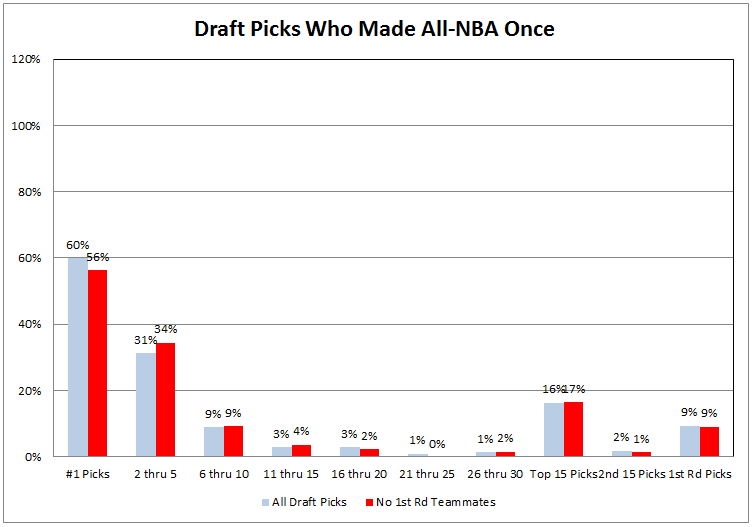
Looking back at the NBA drafts from 1990 to 2009, there were 572 players drafted in the 1st round, and 54 of them made an All-NBA team at least once in their careers. As noted in the chart above, that's a 9% success rate overall. Now, the obvious point is that higher picks have been more successful over that time. But as GM's start to look over this year's potential picks, particularly from teams like Kentucky and UNC that boast multiple prospects, a very important question bears asking. Do GM's fall for players that play with other 1st round talents, even when history says it's a bad idea? To try and answer this, let's look at draft picks in three groups: draftees with no 1st round teammates, draftees with one 1st round teammate, and draftees with two or more 1st round teammates.


First, let's take a look at players who were the only players from their team drafted that year in the 1st round. This by far the largest of the three groups (471 players), and the success rates look largely similar to the generic group. There's honestly not that much interesting stuff in this group, other than remembering the #1 picks that haven't made an All-NBA team: Glenn Robinson, Joe Smith, Michael Olowokandi, Kenyon Martin, Kwame Brown, Andrea Bargnani, and Blake Griffin (for now).


Next up are draftees that had one teammate drafted in the 1st round in the same year. It's a smaller group (68 players), so not every number is meaningful (the only #1 pick in the group was Allen Iverson). It's probably worth noting that of the 8 All-NBA players drafted in this group, 5 of them were the 2nd guy drafted from a team (Latrell Sprewell after Robert Horry, Sam Cassell after Doug Edwards, Vince Carter after Antawn Jamison, Paul Pierce after Raef Lafrentz, Zach Randolph after Jason Richardson). And the 8th guy, Russell Westbrook, was drafted right before Kevin Love, but they'll both be All-NBA players after this season. So, really, out of all the 2 man classes drafted over this period, the All-NBA player was the 2nd guy picked 5 out of 7 times.


Finally, it's the members of the college super-teams, the guys who were drafted alongside at least 2 teammates in the 1st round. 33 players are in this group, and their respective college teams probably ring a bell:

Michigan '90, UNLV '91, Arkansas '92, Kentucky '96, Duke '99, North Carolina '05, Connecticut '06, Ohio State '07, Florida '07, North Carolina '09

While the overall number looks similar (9% hit rate versus all picks at 9%), the number seems deceptive. The three All-NBA players all came within the top 3 picks: Larry Johnson (#1 overall), Elton Brand (#1 overall), and Al Horford (#3 overall). The hit rate is literally nonexistent outside the top 5 picks. The other, hugely important observation: 3 of the 10 first picks off a team (Rumeal Robinson, Larry Johnson, Todd Day, Antoine Walker, Elton Brand, Marvin Williams, Rudy Gay, Greg Oden, Al Horford, Tyler Hansbrough) made an All-NBA team. That means none of the other 23 guys drafted from those super-teams (the 2nd and 3rd best guys on those college teams) hit that level of success.


What, if anything, should be drawn from all this? For me, it reinforces something we all probably know intuitively. College basketball can often involve teams and schedules of very different quality. That difference usually makes it very difficult to project a player's prospects, i.e. the small college star who plays against competition that probably won't make it to the NBA. But, that's most of college - there are over 300 D-1 teams, and 30 NBA teams. If a player's level of competition can make evaluators skeptical, history shows that a player's quality of teammates might require the same treatment.

Does this mean that the NBA draft world is looking at Anthony Davis and Harrison Barnes with rose-colored glasses? Based on the 20 drafts I looked at, no. Views of the best guy on these teams don't seem to get skewed. But should evaluators be careful with John Henson, Tyler Zeller, Kendall Marshall, Terrence Jones, Doron Lamb, and Marquis Teague? Yeah, I think they need to be very careful.

Oh, and maybe take another look at Jeremy Lamb, Tony Wroten, Mason Plumlee, Tyshawn Taylor, Fab Melo, John Jenkins, and Quincy Miller. As of right now, they're all the 2nd guy drafted from their respective college teams.